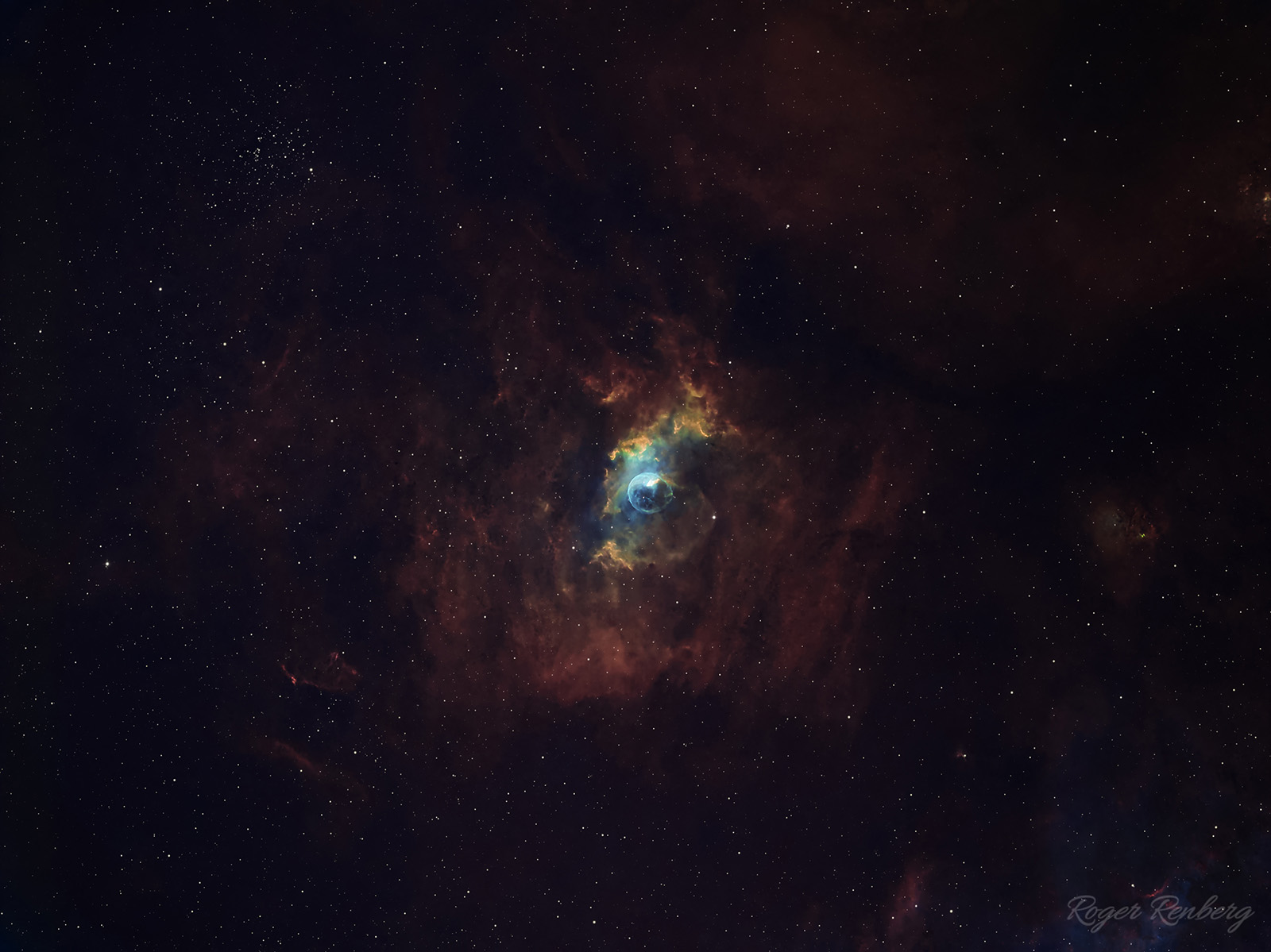
NGC 7635 — The Bubble Nebula
The Bubble Nebula gets its name from the obvious feature — that blue-green shell — but the more interesting thing is that the star responsible for it isn’t quite at the shell’s center. BD+60°2522 is about 45 times the mass of the Sun, and it’s blowing a wind off its surface at something like 1,700 kilometers per second. That wind has been hollowing out a cavity in the molecular cloud around it for the last few hundred thousand years, and the shape of the cavity is set by a standoff between how hard the star can push and how dense the surrounding gas is on each side. The cloud is lumpier on one side than the other, so the bubble isn’t spherical, and the star isn’t centered. You can see both of those things directly — the wall is bright and crumpled at the top where the wind is ramming into thicker, colder material, and stretches thin and diffuse toward the bottom where there’s less to push against.
The blue-green shell is [OIII] — oxygen stripped of two electrons, glowing at the shocked interface where the stellar wind slams into the surrounding cloud. The red around it is Hα: hydrogen in the rest of the molecular complex, being ionized by the star’s ultraviolet output and lit up like a lampshade. Two different physical regimes, two different colors, and the nesting of one inside the other is most of the story — a shock front inside an HII region inside a molecular cloud, all powered by the same star.
The bubble is about seven light-years across. The light I’m recording left it roughly 7,100 years ago, when people on Earth were just starting to smelt copper — it’s been on its way since before bronze was a thing. Got here in pieces, photon by photon, across the nights I was integrating this image.
BD+60°2522 won’t last. Stars that heavy burn through their hydrogen in a few million years, and this one is well into that runway. Eventually it’ll collapse and go supernova, and the cavity it’s carving now will become the easy direction for the blast wave to expand into. The carbon, oxygen, and nitrogen it’s been cooking in its core will get flung out into the galaxy, and some of it will eventually end up in the next generation of stars, planets, and telescopes.
© Roger Renberg