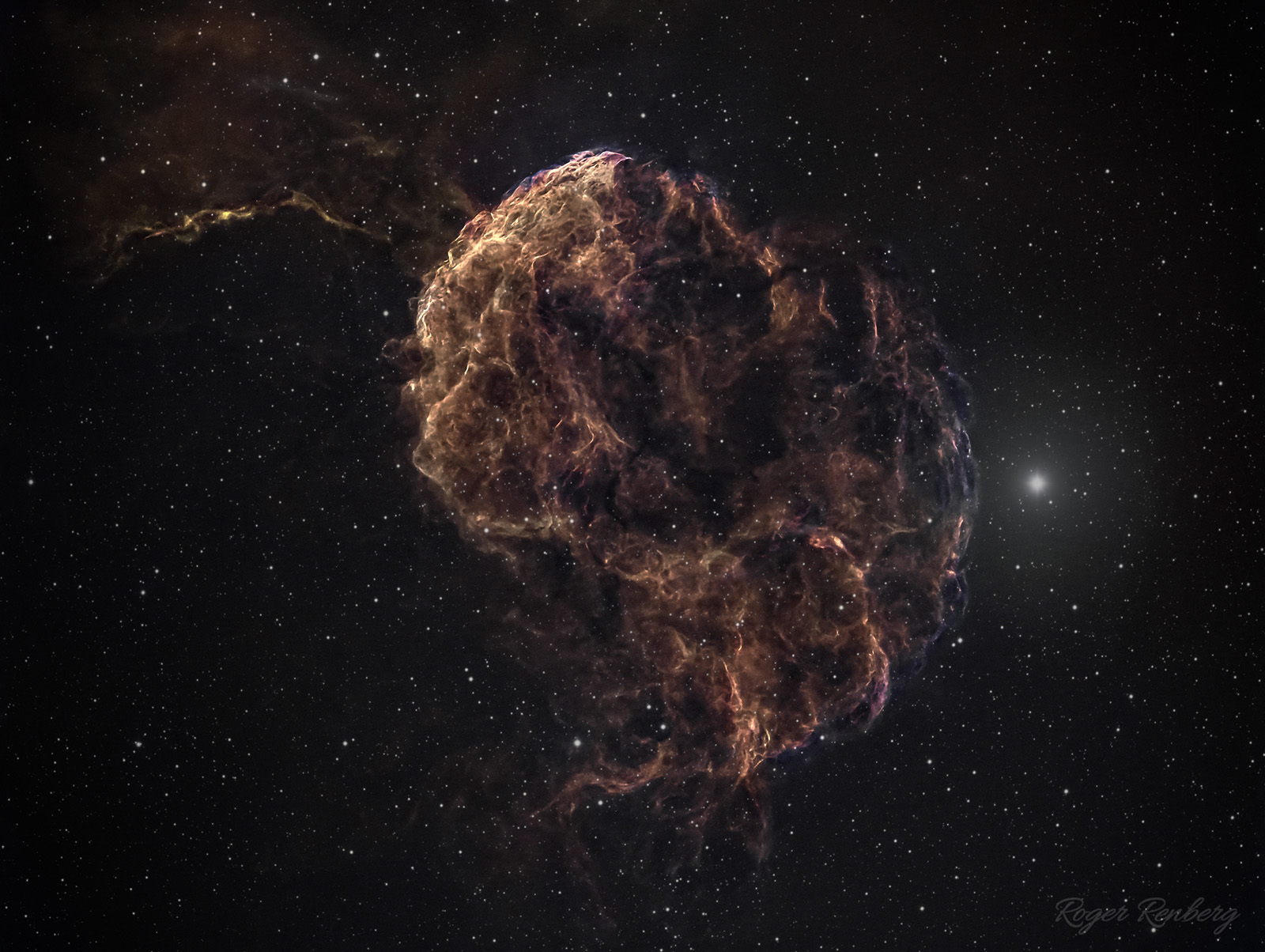
IC 443: A Cosmic Ray Factory, Caught in the Act
At this moment, cosmic rays are passing through your body — protons accelerated to nearly the speed of light somewhere out in the galaxy. They mutate DNA, trip electronics, occasionally set off stray flashes in computer chips or photographic sensors. They pass through you constantly, and they have been passing through every living thing on Earth for as long as there has been life. For decades, astronomers suspected those particles were being manufactured in supernova remnants but couldn’t prove it. IC 443 is one of the objects that finally did.
The Jellyfish sits about 5,000 light-years away in Gemini. A massive star exploded there somewhere between 20,000 and 30,000 years ago — around the time early modern humans in Europe were painting caves at Chauvet and Lascaux. What you’re seeing is the debris field, still expanding outward at hundreds of kilometres per second, glowing as its shock compresses and heats the gas it plows through.
What makes IC 443 particularly useful to science is what it’s running into. The remnant is currently colliding with a dense molecular cloud, and you can see the effect in the image: rumpled, decelerated filaments where the expansion has slowed against dense gas on one side, and a cleaner, rounder edge on the other where it’s still expanding freely. The blue-violet highlights on the eastern rim are doubly-ionized oxygen glowing where the shock runs hottest. The warm copper dominating the interior is hydrogen emission, rendered in bronze rather than the pure red you see in most IC 443 images — a stylistic choice that gives the remnant a warmer, more iron-lit quality than the usual portrait.
In 2013, the Fermi gamma-ray telescope detected a specific spectral feature in IC 443’s emission called the “pion bump” — a signature of high-energy protons slamming into atomic nuclei in the molecular cloud and producing short-lived particles that decayed into gamma rays. It was the first direct proof that supernova remnants really are manufacturing the cosmic rays we’d long suspected they were. The nebula isn’t just beautiful; it’s forensic evidence for a process that has been feeding energetic particles into the galaxy for billions of years.
Buried inside the remnant is a neutron star — the collapsed core of the original star. A city-sized object with more mass than the Sun, spinning fast and drifting laterally through the debris at several hundred kilometres per second, kicked loose by the asymmetric explosion that created it. You can’t see it in visible light. X-ray telescopes can.
The bright star at the right of the frame is Propus (Eta Geminorum), a red giant in the foreground. It has nothing to do with the remnant — just a coincidence of line of sight.
Some of the cosmic rays passing through you right now were born in events like this one. A star’s death, tens of thousands of years ago, still leaving small marks on the living.
© Roger Renberg