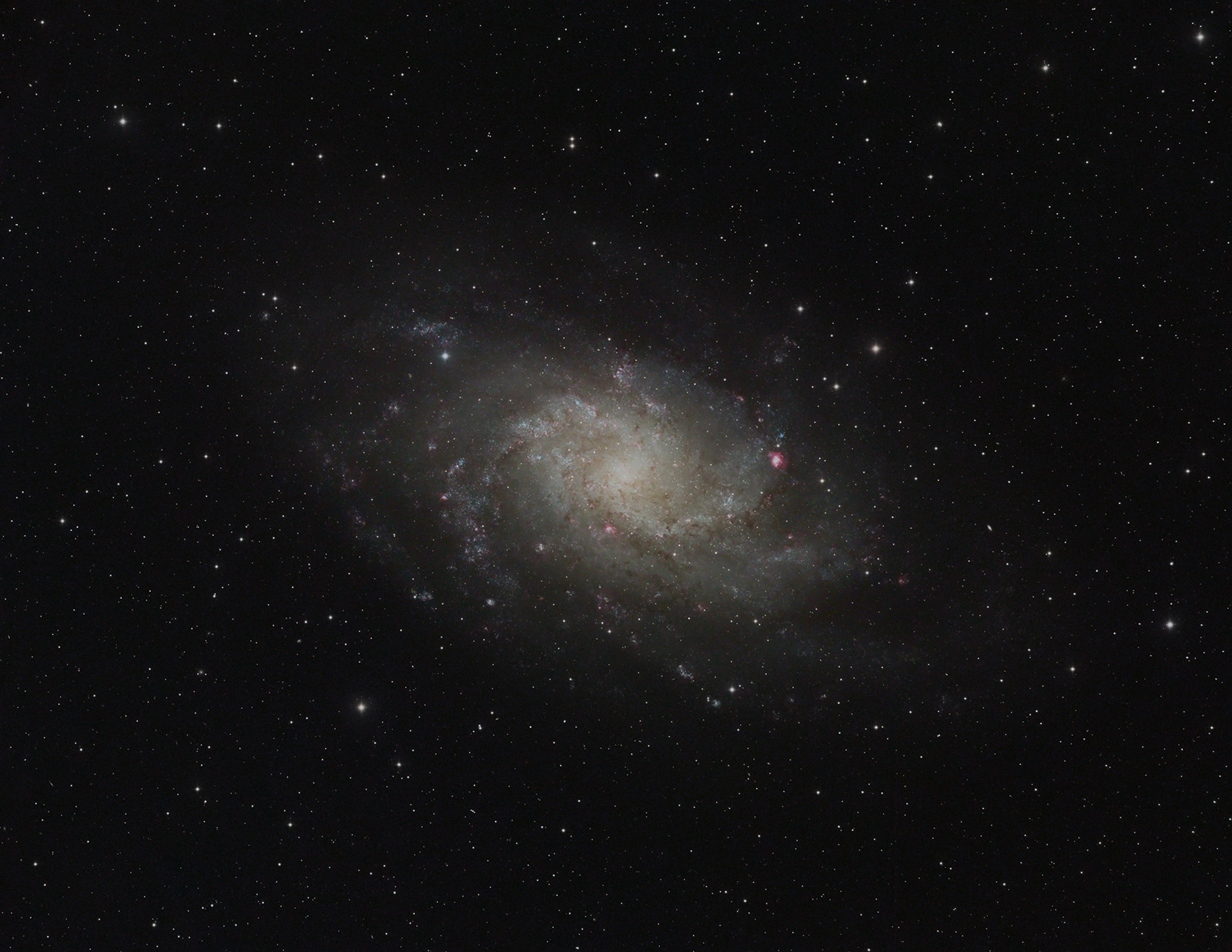
M33 — The Triangulum Galaxy
Every pink knot in this image is a stellar nursery like the ones I’ve been pointing the telescope at from inside our own galaxy — a Rosette, a Heart, a Crescent — but seen from outside, and from 3 million light-years away. M33 is close enough that we can still resolve them individually. Most spiral galaxies at this kind of distance smear into featureless disks; the Triangulum is near enough that its individual HII regions stay pointlike and pink, each one a few hundred light-years of ionized hydrogen being lit up by its own cluster of young hot stars. The largest of them, NGC 604, is about 1,500 light-years across — you could fit the Orion Nebula inside it forty times over, and it’s one of the biggest star-forming regions known in any galaxy.
The pink is Hα, same physics as in every nebula shot I take, just sourced from tens of billions of times more gas and stars in aggregate. The bluer knots are young open clusters, still hot enough to look blue against the older disk. The dust threads cutting across the spiral arms are the same molecular-cloud material our own galaxy’s dust lanes are made of — here it’s silhouetted against the stars behind it instead of the ones in front.
M33 is the third-largest galaxy in the Local Group after Andromeda and the Milky Way, roughly 50,000 light-years across and around 50 billion solar masses including its dark-matter halo. That sounds large, but it’s a few percent of our galaxy’s mass. One strange thing about it: there’s little to no supermassive black hole at the center. Most spirals this size host a few million solar masses of collapsed material in the nucleus; M33’s upper limit is a few thousand at most. Nobody’s fully explained why.
It’s also probably a satellite of Andromeda, tied to M31 by a faint bridge of neutral hydrogen that suggests the two had a close pass around two billion years ago. When Andromeda and the Milky Way finally collide and merge in another four or five billion years, M33 will be pulled into the same event.
The light in this image left the galaxy about 3 million years ago. The oldest stone tools on Earth hadn’t been knapped yet. Our genus Homo didn’t exist. The ancestors of everyone looking at this were a few hundred thousand years off from figuring out how to strike a cutting edge off a river cobble. That’s how long the photons in this image have been in flight to reach my sensor.
© Roger Renberg