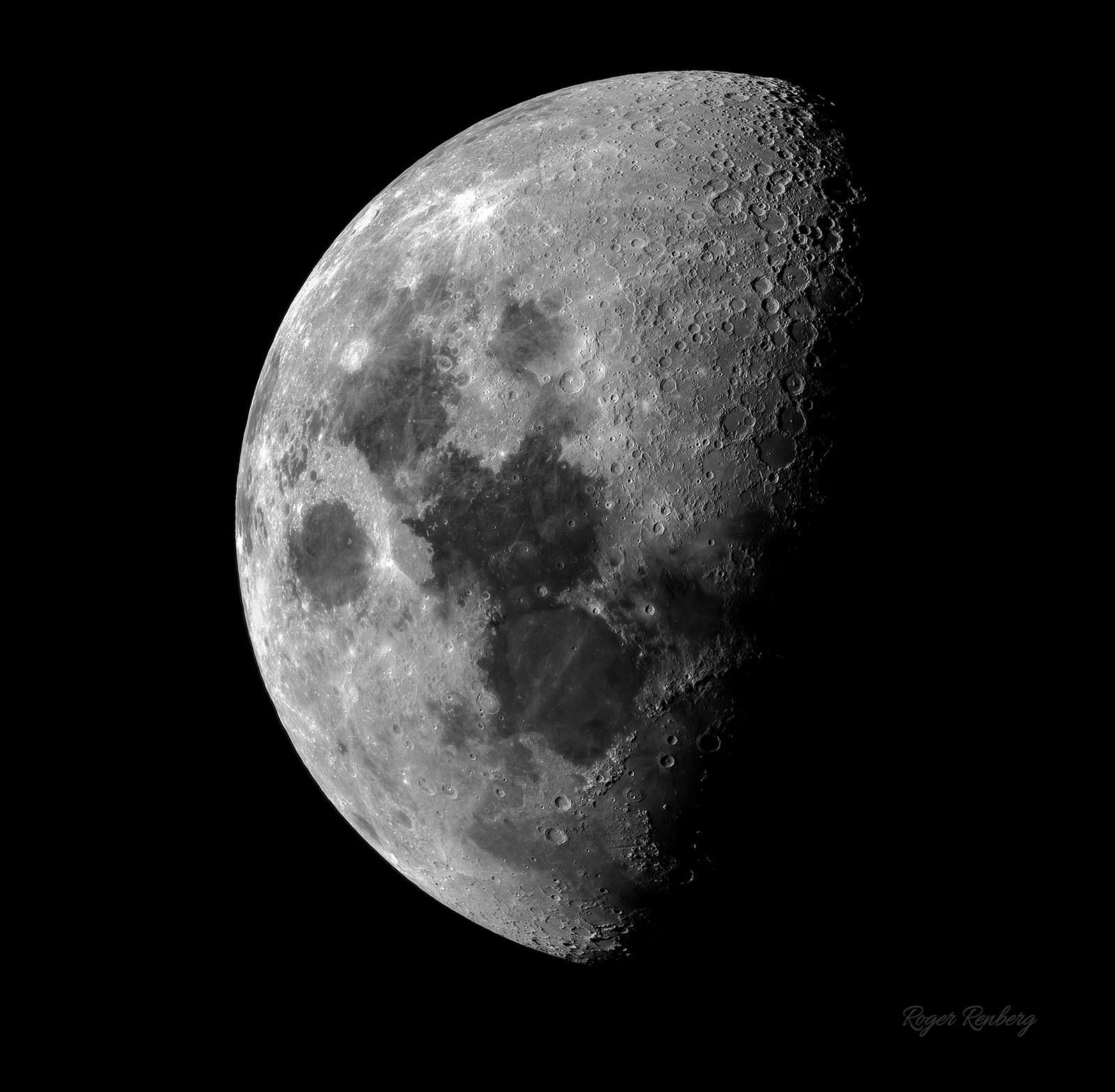
Moon
Every other image on this site shows light that is thousands, millions, or billions of years old. This one is different. The Moon is about 384,000 kilometers away, which means its reflected sunlight reaches the camera in a little over one second. By the standard of everything else I photograph, this is happening now.
It’s worth pausing on what the Moon actually is, because familiarity flattens it. We meet it as small children, see it most nights of our lives, and quietly file it away as ordinary. It is not ordinary. This is a rock with a mass of about 73 quintillion tonnes — 73 followed by eighteen zeros — suspended a quarter of a million miles above our heads with nothing underneath it. Nothing holds it up. It is, in fact, falling: continuously dropping toward Earth under gravity, and continuously missing, because it is also moving sideways fast enough that the ground curves away beneath it as quickly as it falls. That is all an orbit is — falling forever and never arriving. And what keeps it on that path isn’t a cable or a rope or a force tugging on a string; it’s the geometry of space itself, bent by Earth’s mass, with the Moon following the straightest line available to it through curved spacetime. A 73-quintillion-tonne rock, held a quarter-million miles up by the shape of space. We grow up with it hanging there and stop seeing it. It is one of the strangest things in the sky.
The sharpest detail runs along the terminator — the line dividing lunar day from night. There the Sun sits low on the lunar horizon, and every crater rim, ridge, and central peak casts a long shadow that throws the topography into relief. Toward the fully lit limb the Sun climbs overhead, the shadows shorten to nothing, and the surface flattens into low contrast. It’s the same reason a landscape on Earth looks most dramatic at sunrise and sunset, and the reason lunar imagers chase the terminator rather than the full Moon.
The dark grey plains are the maria — Latin for “seas,” named by early observers who took them for water. They’re actually vast sheets of solidified basalt, where lava welled up and flooded the largest impact basins between roughly 3 and 3.5 billion years ago. The basalt is iron- and magnesium-rich, which is why it reads darker than its surroundings. The brighter, more heavily cratered terrain is the lunar highlands — older crust, closer to 4.4 billion years old, made largely of pale anorthosite. Crater density works as a rough clock: the more impacts a surface has accumulated, the longer it has been exposed, so the bright highlands are ancient and the dark maria are comparatively young.
The Moon itself is about 4.5 billion years old and most likely formed from the debris of a collision between the early Earth and a Mars-sized body. What condensed out of that wreckage is, in a real sense, a piece of the early Earth. It has since become tidally locked — it rotates exactly once per orbit, so the same hemisphere always faces us. Everything visible here is the near side. The far side, which no one saw until a Soviet probe photographed it in 1959, looks markedly different, with far fewer maria.
This frame is flipped from the naked-eye view — a deliberate choice for the composition, not an error. A telescope inverts or mirrors the image depending on the optical path it takes to the camera, so which way is “up” on the Moon is a matter of convention rather than a fixed truth.
The Moon is also slowly leaving. Tidal interaction with Earth transfers angular momentum outward, and the Moon recedes by about 3.8 centimeters a year — roughly the rate fingernails grow. It was closer and loomed larger in the sky when the first life appeared on Earth, and it will be a smaller disk in the deep future, eventually too small to fully cover the Sun during an eclipse. For now it sits close enough that its light reaches us in the time it takes to say the word.
© Roger Renberg