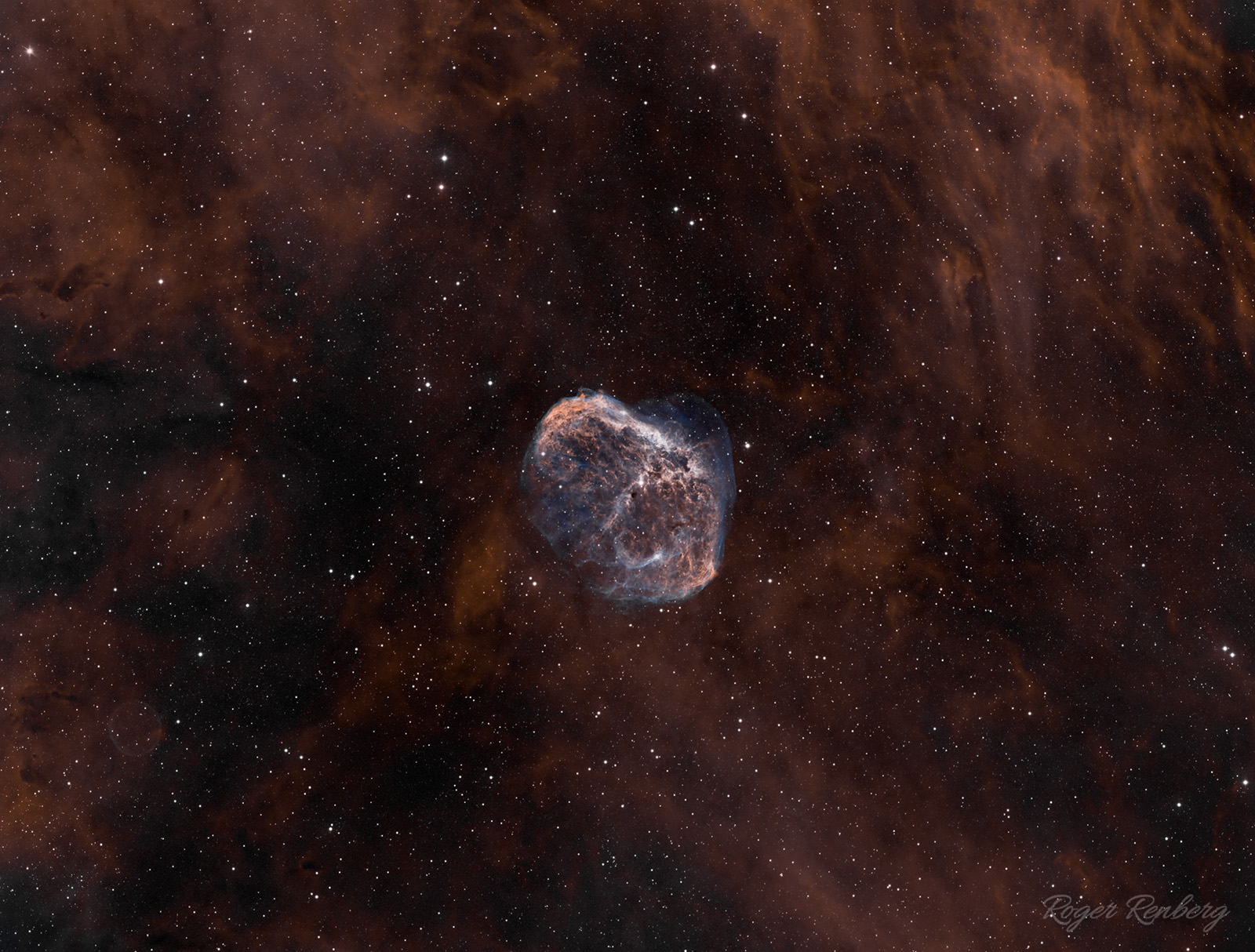
NGC 6888: A Star’s Last Hundred Thousand Years
Every time I point a telescope at the Crescent Nebula, I’m looking at a star that might already be dead.
WR 136, the Wolf-Rayet star at the heart of NGC 6888, sits about 5,000 light-years away in Cygnus. The light reaching my sensor tonight left that region around the time early Egyptians were inventing writing. In the five millennia in between, the star could already have exploded as a supernova and we simply wouldn’t know yet — the news is still in transit. This nebula is, in a real sense, a pending update from the past.
What the image shows is a massive star in the act of killing itself, photographed in mid-performance. WR 136 started out around 25 solar masses. It burned through its hydrogen core fast — massive stars live on geological fast-forward — and has since shed something like ten Suns’ worth of its own material in a succession of stellar winds. The crescent shape is the record of those winds arriving in two phases. First came a slow, dense wind from the star’s earlier red supergiant phase, drifting outward at roughly 20 km/s for tens of thousands of years. Then came the current Wolf-Rayet wind — thin, hot, and moving at 1,500 km/s — which caught up with the slower material and slammed into it. The collision shock-heated the gas and compressed it into the glowing filaments you see now. The crescent is the wreckage of that two-phase stellar autobiography.
The colors trace physics, not artistry. Hydrogen glows red, oxygen glows cyan, and the precise intensity at each wavelength tells you the temperature, density, and ionization state of the gas in that region. The dark interior cavities are places the current fast wind has already evacuated. The fine filamentary structure is the shape of the shock front itself.
WR 136 is probably within the last few hundred thousand years of its life, possibly considerably less. When it finally goes, it will scatter freshly-forged carbon, oxygen, nitrogen, and heavier elements into the surrounding gas — the same gas that will eventually cool and collapse into the next generation of stars and planets. If you want to see the actual mechanism by which the universe enriches itself with heavier elements, this is it, happening in real time: a star preparing the raw material for its own replacement. And when the supernova light finally arrives, however many millennia from now, it will outshine every other star in the sky for a while.
© Roger Renberg