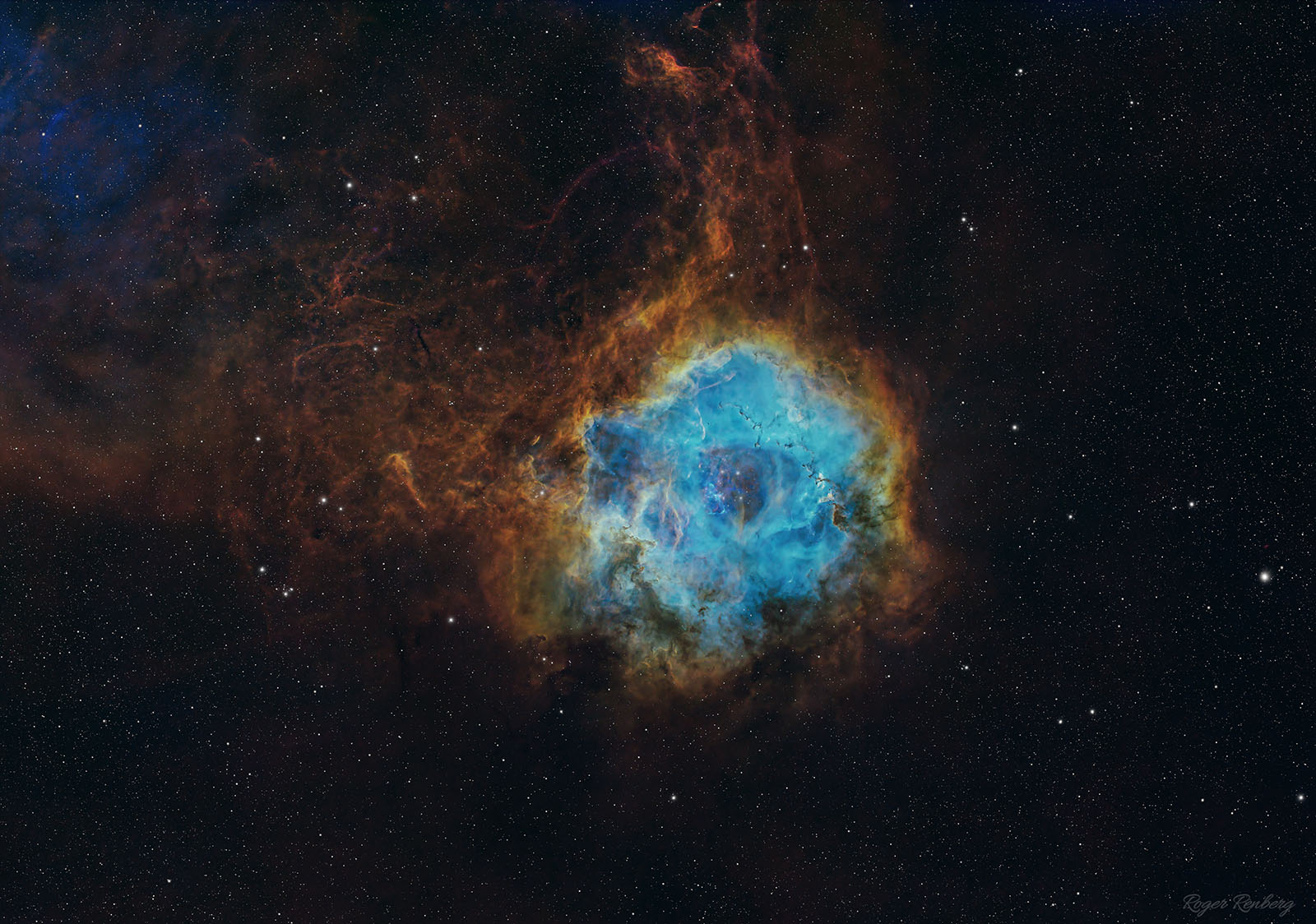
The Rosette and Its Complex
Most shots of the Rosette zoom in on the bright central bubble and crop out everything else. I wanted to catch more of the surrounding molecular cloud than the usual tight crop allows, because the Rosette doesn’t really end where the obvious “rose” shape does — it’s just the brightest part of a much larger star-forming region.
Inside the bright cavity the physics is the same as in any wind-blown HII region. NGC 2244, the open cluster visible in the dark interior, is a few million years old and contains several O-type stars whose combined ultraviolet output and stellar winds have evacuated a cavity about 50 light-years across in the molecular cloud that formed them. The cyan interior is [OIII] — doubly ionized oxygen, which requires high-energy photons to produce and traces the hottest ionized gas closest to the cluster. The orange-tan rim is Hα and SII, lower-ionization emission from denser, cooler material at the photoevaporation fronts where UV from the cluster is still slowly eating its way outward into the cloud.
The wider context is what the tight crops usually miss. The molecular cloud hosting the Rosette is much larger than the illuminated bubble; the filaments reaching out beyond the obvious rose shape are the same ionized gas, just much fainter because they sit farther from the ionizing source. The whole region is part of a giant molecular cloud complex about 100 light-years across, with multiple sites of active star formation threading through it. NGC 2244 happens to be the flashiest young cluster, not the only one.
The dark finger-like structures along the inner rim of the cavity are denser globules that have held out against photoevaporation longer than their surroundings. Some of them have new stars forming in their cores, shielded by the same density that’s made them resistant to the UV. The cluster tearing down its parent cloud is also compressing the leftovers into the next generation of stars.
The Rosette is about 5,000 light-years away in Monoceros. The light in this image left the nebula roughly when the first writing was being invented in Sumer. The cluster itself has been shining for a few million years — on a human scale essentially forever; on a stellar scale, just getting started.
NGC 2244’s biggest stars will go supernova within a few million more years. When they do, the blast waves will shred what’s left of the cavity walls, expand through the pre-carved interior along the path of least resistance, and eventually push into the larger complex outside, compressing denser clouds there and probably triggering a downstream round of star formation. Every part of this image is either debris from a previous generation of stars or preparation for the next.
© Roger Renberg