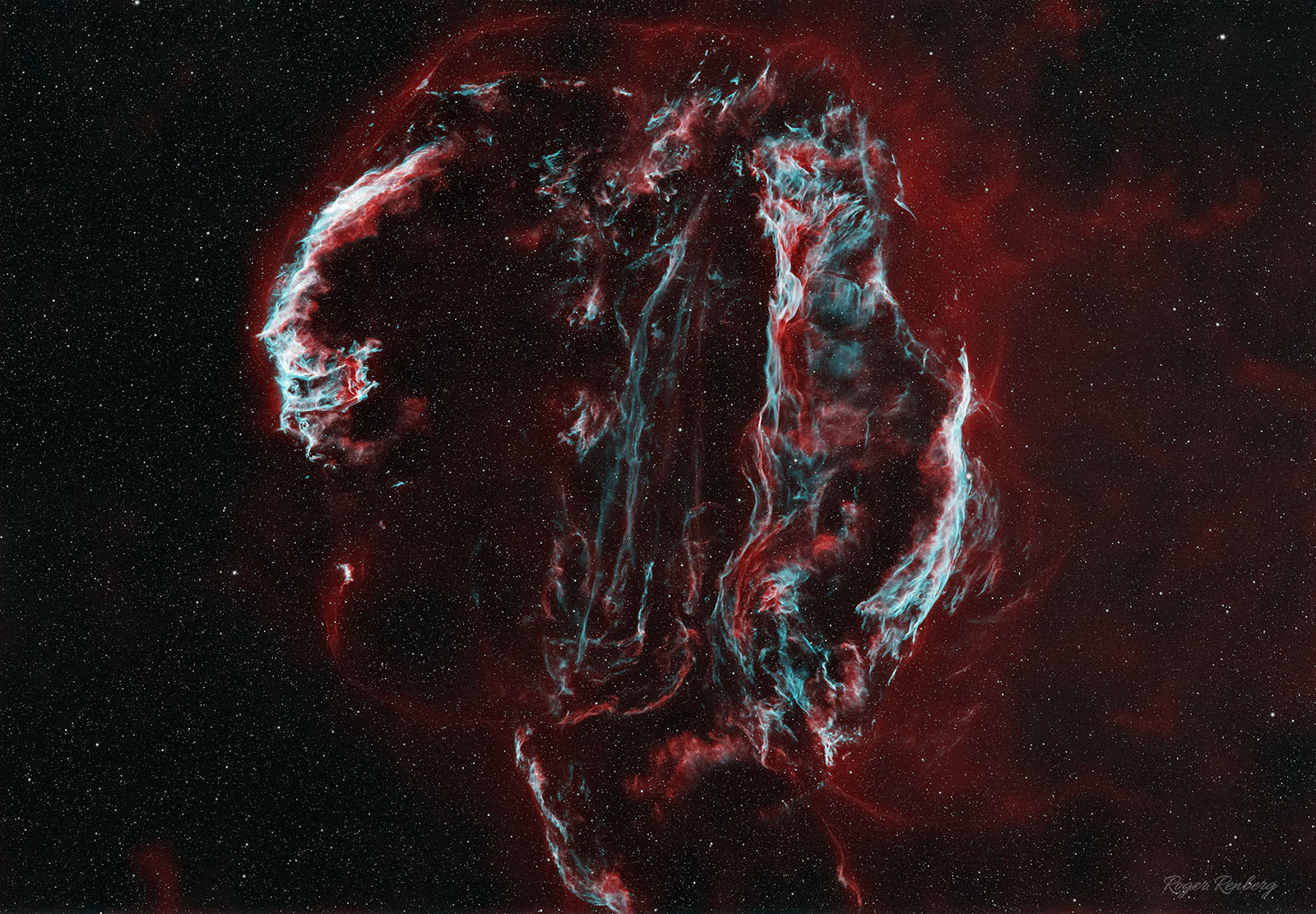
The Cygnus Loop
What I’m looking at here is still expanding. The Cygnus Loop is a supernova remnant — the shell of stellar debris left behind by a massive star that exploded in Cygnus somewhere between 10,000 and 20,000 years ago, still coasting outward at a couple hundred kilometers per second. At roughly 2,400 light-years away, the whole bubble is about 120 light-years across and covers close to three degrees on the sky.
The filamentary appearance is the standard supernova-remnant projection effect: what looks like a tangle of cords is actually a thin, crumpled sheet of shocked gas, bright only where the sheet folds tangent to our line of sight and the emission stacks up along the way. The red filaments are Hα from hydrogen recombining behind the cooler parts of the shock. The cyan is [OIII] from hotter regions where temperatures still exceed a few hundred thousand kelvin.
There’s an unusual open question about this remnant: we don’t know where the compact object is. A core-collapse supernova should leave a neutron star or a black hole behind, and for a remnant this young and this close, we’d expect to have found it by now. Deep searches across X-ray and radio haven’t turned up anything definitive. Either the neutron star was kicked far enough from the geometric center that it’s outside the usual search area, its radio beam doesn’t happen to sweep past Earth, or the progenitor was strange in some way we haven’t sorted out yet. The Cygnus Loop is one of only a handful of young SNRs with no confirmed central object.
The light in this photo left the Loop around 2,400 years ago. On Earth that’s classical antiquity — around the time of Socrates’ trial in Athens, Herodotus writing the Histories, Confucius a generation gone in China. But the more interesting clock is the explosion itself. That happened 10,000 to 20,000 years ago — the late glacial to early Holocene — when mammoths were still alive in Siberia and the first humans were crossing into the Americas. At 2,400 light-years, a core-collapse supernova would have peaked around apparent magnitude −8, brighter than any planet and easily visible in daytime for weeks. Someone certainly noticed. No records exist, but the event was seen.
The shell keeps expanding. Another hundred thousand years from now the Cygnus Loop will have faded into the background and become indistinguishable from the rest of the galaxy’s diffuse gas — its heavy elements mixed into the clouds that will eventually form new stars. That’s how most of the non-hydrogen anywhere around us got distributed in the first place: one old star at a time, blown outward by shocks like the ones in this image.
© Roger Renberg