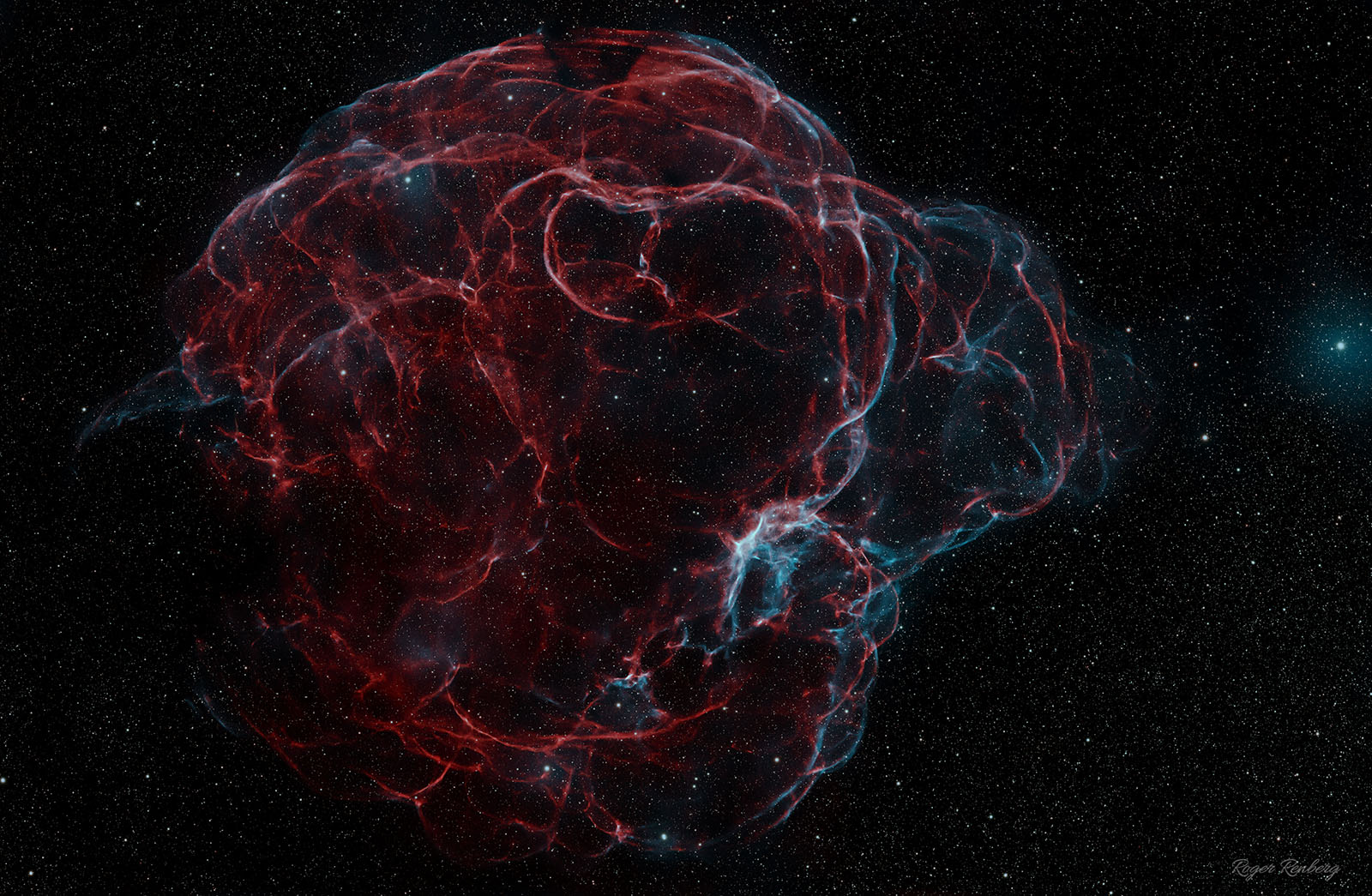
Simeis 147 — The Spaghetti Nebula
Every filament in this image is a shock front, and they’re all moving outward from the same point. Simeis 147 is a supernova remnant — the debris of a massive star that collapsed and exploded about 40,000 years ago, seen now as the tangled web of expanding gas it left behind.
The progenitor was a high-mass star, probably something in the 8 to 20 solar mass range, that ran out of fuel in its core and couldn’t support its own weight against gravity. When the collapse happened, the outer layers were blown off at around 10,000 kilometers per second — roughly 3% the speed of light. Over 40,000 years of expansion, the shell has slowed down by plowing into the surrounding interstellar medium, and is now moving outward at more like 80 to 100 km/s. The shell has grown to about 150 light-years across, which makes Simeis 147 one of the largest supernova remnants in the sky.
The red filaments are Hα — hydrogen recombining behind the shock fronts. The blue-cyan filaments are [OIII], from hotter regions where the temperature is still high enough to doubly ionize oxygen. The whole thing looks threadlike because that’s what radiative shocks look like edge-on. The actual structure is a thin, crumpled shell; where it happens to fold tangent to our line of sight, it stacks up into a bright filament, and where it points away, it mostly disappears.
The original explosion left behind a neutron star — PSR J0538+2817, a pulsar offset from the geometric center of the remnant. The offset exists because the explosion was asymmetric and kicked the neutron star out at close to 400 km/s. You can trace its proper motion back from where it is now to where the SNR’s center used to be, and the age the trajectory gives you matches the age of the remnant. The pulsar and the nebula tell the same story.
Simeis 147 is about 3,000 light-years away, so the light in this photo left it around 3,000 years ago. On Earth, that’s the late Bronze Age — iron working spreading out of Anatolia, Phoenicians trading along the Mediterranean, roughly the traditional dating of the Trojan War.
But the more interesting clock isn’t the 3,000-year light-travel time — it’s the 40,000 years since the star actually exploded. Light from the original blast reached Earth around 40,000 years ago, during the Upper Paleolithic. Anatomically modern humans had been in Europe for a few millennia by then. Neanderthals were still alive in some refugia. The oldest known cave paintings date to not long after. At 3,000 light-years away, a typical core-collapse supernova would have peaked brighter than Venus, easily visible in daytime for weeks. Someone saw a new star appear one evening, watched it get brighter over days, watched it slowly fade across months. No records survive; people that far back didn’t leave us those. But it happened, and what