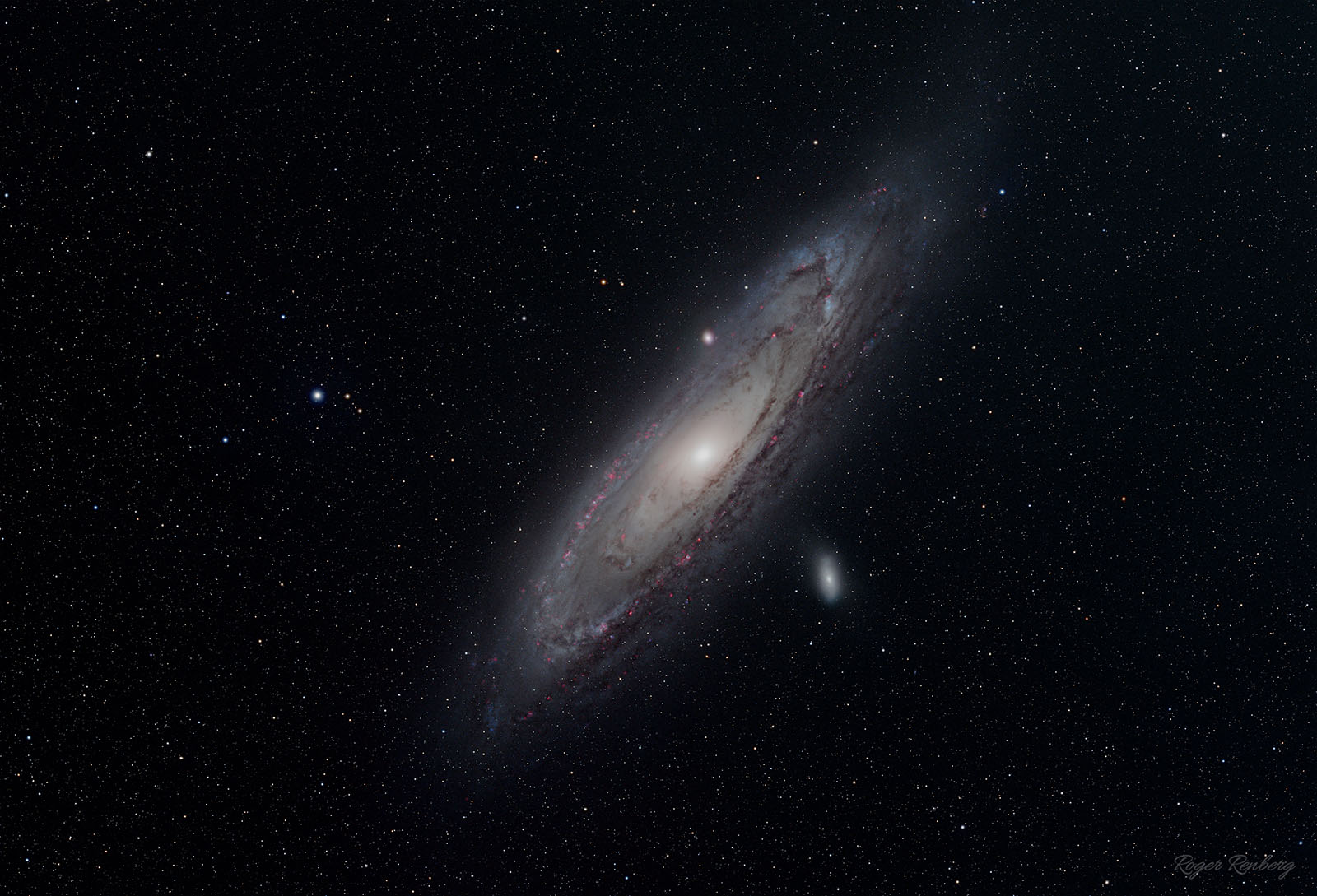
M31 — The Andromeda Galaxy
The big tilted disk is M31, the Andromeda Galaxy — our closest large-galaxy neighbor at about 2.5 million light-years. The small bright elliptical near the disk’s edge is M32, one of two dwarf companions that orbit M31 as gravitationally bound satellites.
M31 is the biggest galaxy in the Local Group by stellar count, around 150,000 light-years across and holding roughly a trillion stars — two or three times the Milky Way’s total. Its disk is tilted about 77 degrees to our line of sight, which is nearly but not quite edge-on. That angle is what makes an image like this useful: steep enough that you can see the silhouette of the dust lanes against the bulge, shallow enough that the spiral arms still spread out instead of stacking on top of each other. The dark bands threading across the brighter regions are dense molecular clouds absorbing starlight from behind — the same material our galaxy’s dust lanes are made of. The pink knots scattered along the arms are Hα from HII regions, ionized hydrogen lit by clusters of young hot stars.
M32 is worth a second look. It’s one of the densest galaxies known — not just a standard dwarf elliptical, but almost certainly the stripped core of something once much larger. Recent work suggests M31 underwent a major merger with a now-destroyed sibling galaxy, sometimes called M32p, around two billion years ago. The small compact ball you can see parked against M31’s disk is the surviving nucleus of what got eaten.
M31’s own nucleus hosts a supermassive black hole of about 100 million solar masses. That’s much larger than the Milky Way’s four-million-solar-mass black hole, but not exceptional for a spiral this size.
Andromeda is approaching the Milky Way at about 110 kilometers per second along our line of sight. The two galaxies are going to collide and eventually merge somewhere around four billion years from now. The collision won’t be violent in the movie sense — stars are so sparse relative to galaxy volume that almost no individual stars will actually hit each other — but the gravitational disruption will rearrange both disks entirely, trigger a burst of star formation as the gas reservoirs mix, and leave behind a single giant elliptical galaxy a couple billion years after that.
The light in this image left M31 about 2.5 million years ago. On Earth, that’s almost exactly when our genus Homo was appearing in East Africa and when the first stone tools were being knapped. The photons in this picture are as old as our lineage.
© Roger Renberg