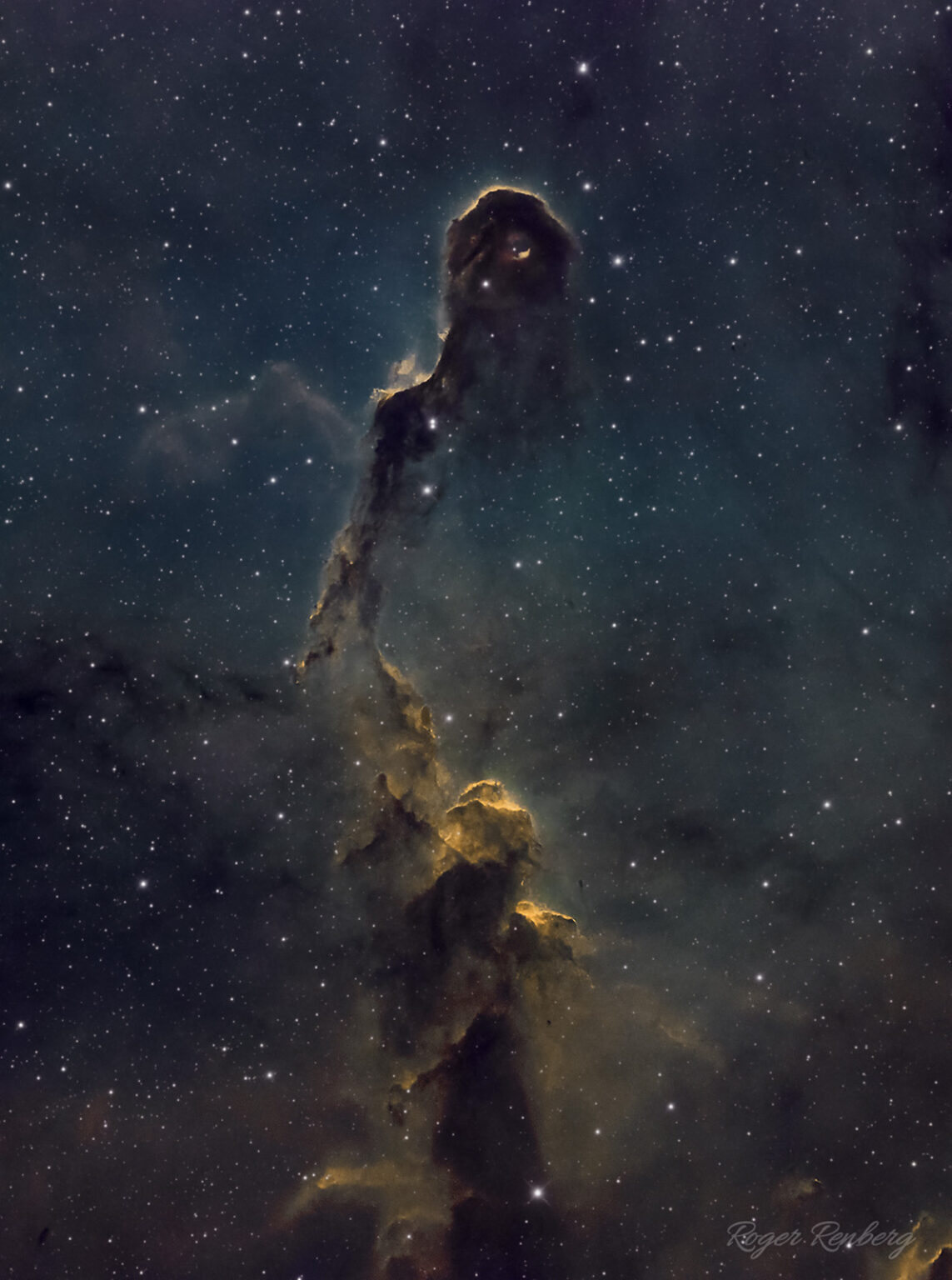
If you zoomed one of the pillars in the Rosette or the Heart Nebula way in, this is the kind of thing you’d see. The Elephant’s Trunk is a textbook example of a photoevaporation pillar — a dense column of molecular gas slowly being eaten from the outside by ultraviolet radiation, while the inside holds out long enough to form stars.
The radiation source is HD 206267, an O-type multiple system near the center of the much larger IC 1396 HII region, several tens of light-years from the trunk itself. HD 206267’s UV output has been bathing this whole area in ionizing photons for a few million years. Wherever that radiation hits diffuse gas, it ionizes the hydrogen and blows the material outward. Wherever it hits something dense enough to resist, it erodes the lit side more slowly than it can photoionize it, and what’s left gets sculpted into the classic teardrop or trunk shape — always tapering away from the source. The bright gold rim running along the edge of the trunk is that ionization front: the photoevaporation boundary where UV meets the last neutral hydrogen atoms in the dense gas and ionizes them on their way out.
The trunk is about 20 light-years long. The blue-green diffuse glow around it is [OIII] emission from the ionized gas filling the larger HII region — doubly ionized oxygen, which needs high-energy photons to produce. The dark interior of the trunk itself is shielded from the UV and still cold and molecular, the last remnant of the original cloud the pillar came out of.
The interesting detail is at the head. There’s a small bright source tucked inside a dark cavity near the top of the trunk — a young star that has formed inside the pillar and is already clearing its own local pocket in the gas. The triggering mechanism is called radiation-driven implosion: the ionization front compressing the column from the outside drives shocks inward, and if they raise the density in a dense core enough, gravitational collapse takes over. The star that forms is working against its parent pillar from the inside while the outside is being eaten from without. The trunk is a stellar nursery that’s also its own grave.
The light in this image left IC 1396A about 2,400 years ago. On Earth, that’s around when Plato was writing the Republic — classical Athens, a generation after Socrates.
In another few hundred thousand years the trunk will be gone. The pillar will erode down to a handful of denser globules, and eventually those will evaporate too. Whichever young stars have finished forming by then will be stranded in a now-transparent region, once the cloud that made them has been turned entirely into ionized gas and blown out of the way. They’ll emerge as part of an open cluster, their histories indistinguishable from stars that formed under calmer conditions.
© Roger Renberg