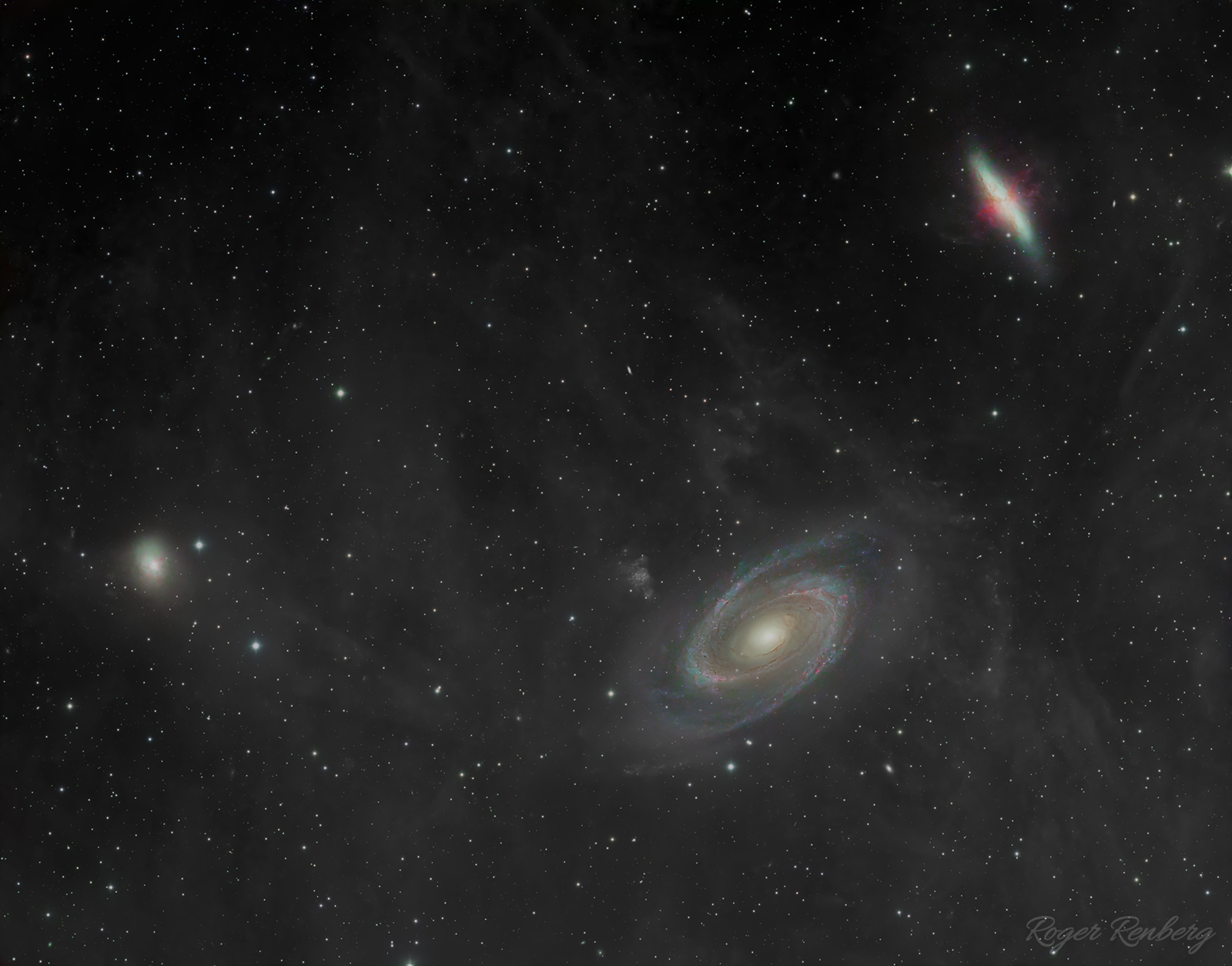
M81, M82, and the M81 Group
What I like about this frame is that it has three different physics stories sitting at three wildly different distances, and they’re not labeled.
The scattered point-source stars are in our own galaxy, a few hundred to a few thousand light-years away. The faint gray wisps threading through the whole image aren’t gas between the galaxies — they’re in the Milky Way too. That’s the “integrated flux nebula,” or galactic cirrus: cold dust in our galaxy’s halo, lit not by any single star but by the combined light of the entire galactic disk shining up through it from below. It’s one of the hardest things to pull out of a deep image; if you can see it, you’ve got clean skies and a lot of integration time.
Everything else — the three galaxies — is around 12 million light-years away in Ursa Major. The big spiral is M81, also called Bode’s Galaxy: a classic grand-design spiral about 90,000 light-years across, with a well-organized bar and a supermassive black hole at the center estimated around 70 million solar masses, one of the more massive ones in the nearby universe. The edge-on disk with the red plumes is M82, the Cigar Galaxy. The smaller fuzzy one is NGC 3077.
The red plumes off M82 are the main event. M82 is a starburst galaxy — it’s forming stars at roughly ten times the rate of the Milky Way, concentrated in its central few hundred light-years. When you pack that much massive-star activity into that small a volume, enough supernovae go off in quick succession that their combined blast waves merge into a single galaxy-scale outflow. The pink is Hα from ionized hydrogen being blown out of the disk perpendicular to the plane, at hundreds of kilometers per second, forming a bipolar superwind that extends up to 30,000 light-years above and below the galaxy. That’s star formation violent enough to vent itself into intergalactic space.
The reason M82 is burning that hot is M81. Roughly 200 to 300 million years ago the two galaxies had a close gravitational encounter — close enough to funnel most of M82’s gas into its center, which lit the starburst, and close enough to pull a neutral-hydrogen tidal bridge out of all three galaxies that still stretches between them. NGC 3077 is caught up in the same interaction. The HI bridge doesn’t show up in optical images, but the whole trio is physically tied together by it.
The light in this photo left those galaxies about 12 million years ago. On Earth, that’s deep in the Miocene — before the ape lineages that would become gorillas, chimps, and humans had split from each other. The photons have been traveling since before any of our ancestors were recognizably our ancestors.
© Roger Renberg