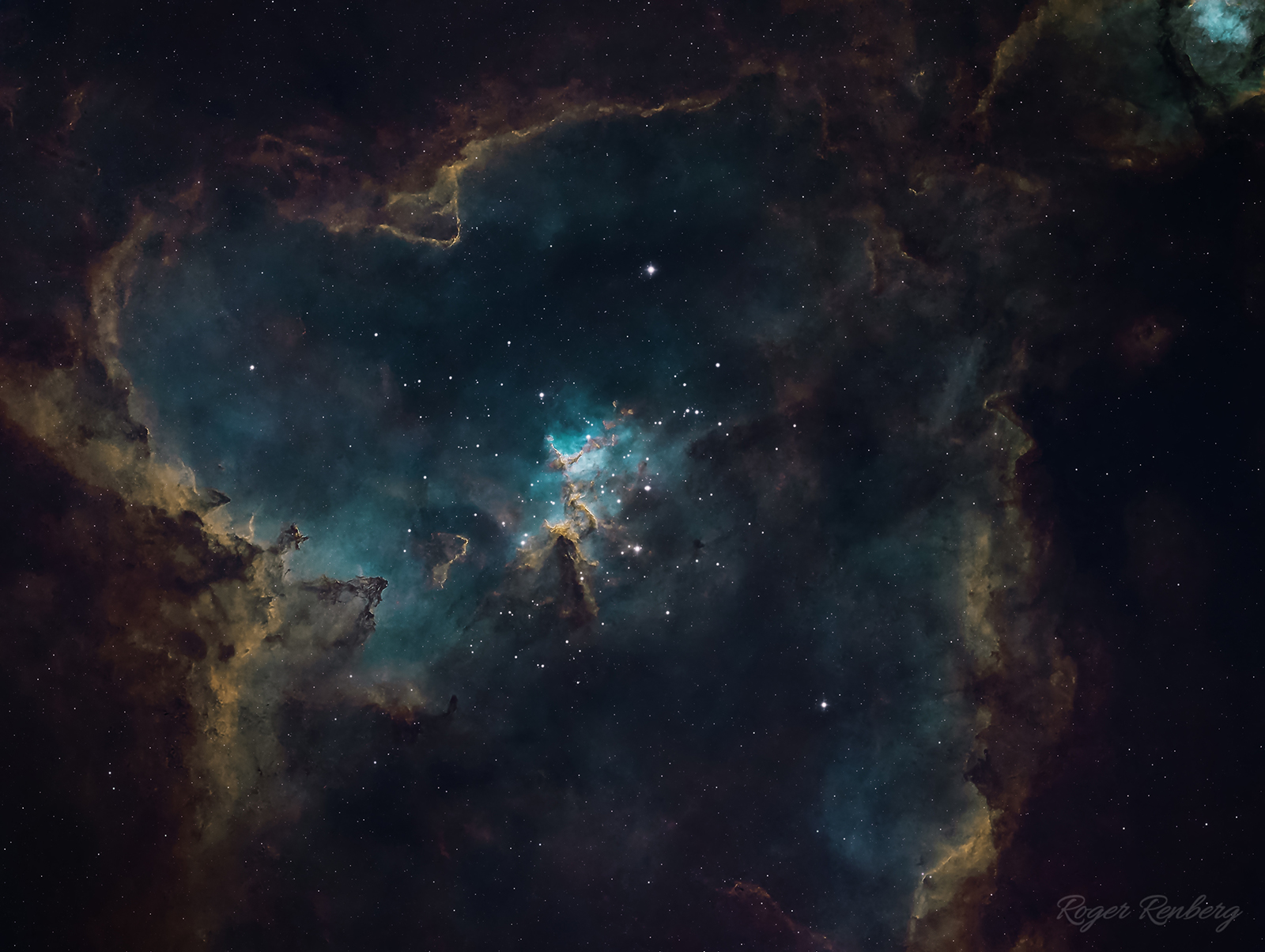
Melotte 15 — The Cluster Inside the Heart Nebula
Most shots of the Heart Nebula are wide-field, showing the whole 165-light-year heart shape. This one is zoomed into what’s actually driving it: Melotte 15, the young open cluster at the center of the cavity.
The cluster is only a couple million years old, barely settled onto the main sequence, and some of its members are extreme. HD 15558 is a binary sometimes estimated near 150 solar masses combined — among the most massive known in the galaxy. HD 15570 is an O-type supergiant in the 50-to-70 solar mass range. Stars that heavy burn through their hydrogen in a few million years instead of ten billion. This whole group is living fast.
Their combined UV output and stellar winds are what’s lit and carved everything around them. The cyan glow wrapping the stars is [OIII] — doubly ionized oxygen, which takes high-energy photons to produce and traces the hottest gas closest to the source. The orange-tan of the pillars and knotted structures farther out is SII and lower-ionization emission: denser, cooler material at the photoevaporation fronts where UV from the cluster is whittling the clouds down from their lit sides. The dark sinuous shapes running through it all are what’s left of the original molecular cloud — still shielded enough in their cores to hold together for now.
The pillars and finger-like structures near the cluster work the same way as the ones in the Eagle or the Rosette: they’re the clumps dense enough to resist ablation longest, getting progressively sculpted into those teardrop and fin shapes, always pointing away from the ionizing source. A few of them have new stars forming in their densest cores, hidden from view, fed by the same pressure that’s trying to destroy them.
The light in this image left Melotte 15 about 7,500 years ago — around the time copper smelting was first spreading through Anatolia, before writing, before the wheel. The cluster itself is a couple million years older than that, and its heaviest members have maybe a few million more before they collapse as supernovae. When that happens, they’ll finish clearing the Heart Nebula and blow their fused carbon, oxygen, and iron into the surrounding galaxy — seed stock for whatever forms next.
© Roger Renberg