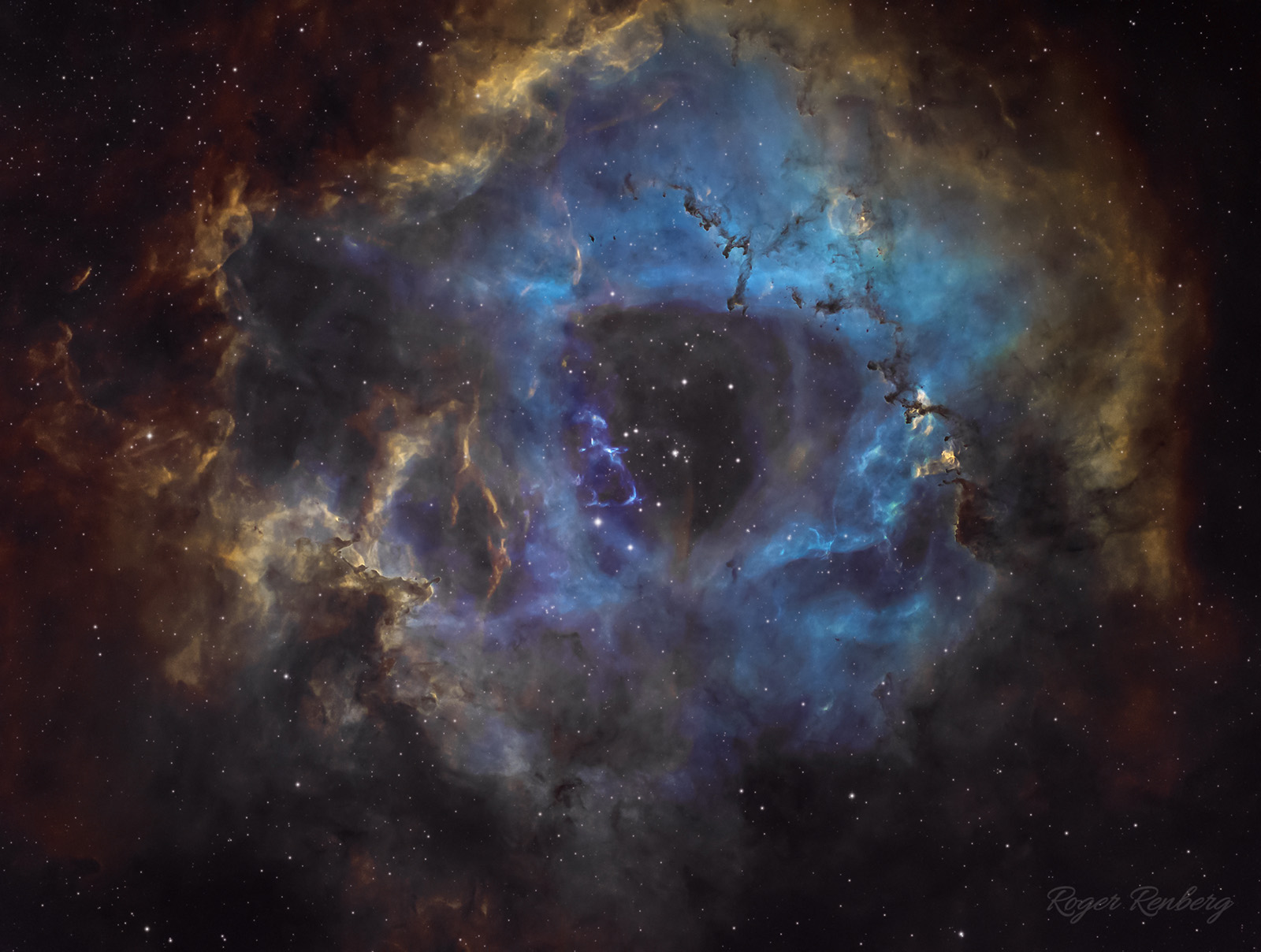
The Rosette Nebula
What makes the Rosette interesting is the hole in the middle of it. At the center of the nebula, inside the dark oval cleared of gas, there’s a cluster of young hot stars called NGC 2244 — only a few million years old, and the reason the whole thing looks the way it does. The brightest members are O-type stars, tens of solar masses each, pumping out ultraviolet light and stellar winds strong enough to have evacuated a cavity about 50 light-years across. That dark interior isn’t empty space; it’s the volume the cluster has cleared.
The color gradient is the record of that clearing. Right around the stars, where radiation is most intense, the gas is ionized to high states — oxygen stripped of two electrons glows in those blue and cyan tones. Farther out, where UV photons have been absorbed and re-absorbed and the gas is cooler and denser, you get the yellow-orange signature of sulfur and lower-ionization species holding out against the pressure. Blue at the interior, orange-tan at the rim, is an ionization-stratification map — the cluster’s influence fading with distance.
The dark curtains and finger-like pillars along the rim are where the cleanup isn’t finished. Those are denser clumps of the original molecular cloud, still shielded enough inside to survive, slowly being whittled down from their lit sides by the same UV that carved the cavity. Some of them have new stars forming in their densest cores — the irony of the Rosette is that the cluster tearing the cloud apart is also compressing its leftovers into the next generation of stars.
The whole complex is about 130 light-years across, roughly 5,000 light-years from us in Monoceros. The light I’m recording here left the nebula around the time the first writing was being invented in Sumer. The cluster itself started shining a few million years before that — roughly the span humans have been making stone tools.
NGC 2244’s most massive stars won’t make it much further. Within a few million years the biggest ones will go supernova, pushing another shock wave through whatever’s left of the cloud and triggering more collapse in the pillars that haven’t finished eroding yet. The same star factory tearing itself apart is also seeding its successor.
© Roger Renberg