NGC 891 and Abell 347: A Line of Sight
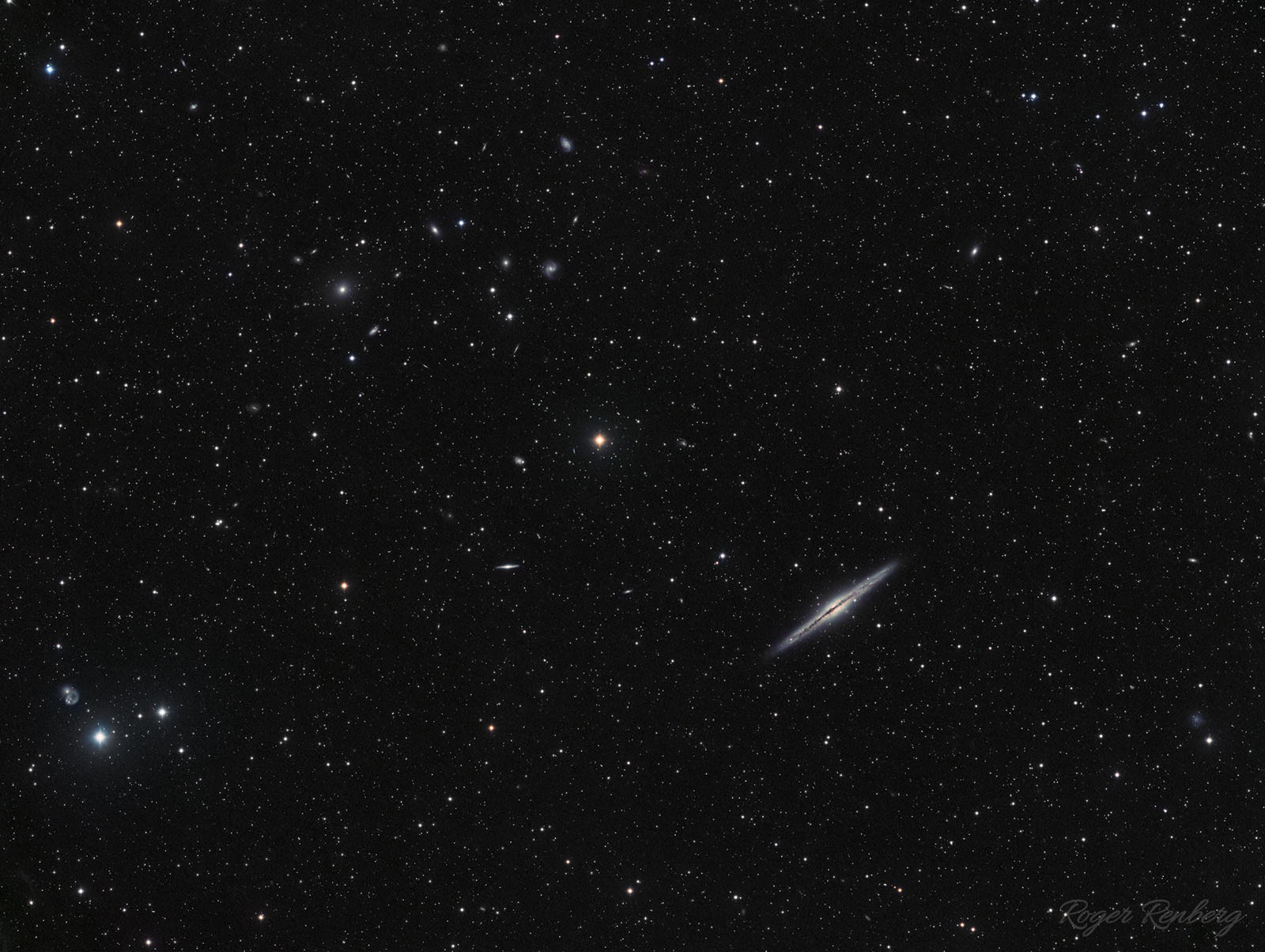
This frame looks like a gathering of galaxies that all happen to live together. It isn’t. The objects here are separated by radically different distances, and the fact that they share the image is an accident of geometry, not a cosmic reunion.
The needle-thin streak dominating the right side is NGC 891, a nearly edge-on spiral galaxy in Andromeda about 30 million light-years away. It’s frequently described as a Milky Way analog, and for good reason: similar mass, similar Sb classification, a disk roughly 100,000 light-years across, the same two-component structure of a thin star-forming disk embedded in a thicker stellar halo. If you could turn our own galaxy ninety degrees and look at it from the outside, this is approximately what you’d see. The dark band bisecting the disk is concentrated dust and molecular gas in the galactic midplane, where active star formation lives.
The detail worth lingering over is at the disk edges. Extending vertically out of the plane are faint filaments and wisps — “dust chimneys” reaching hundreds of parsecs above and below the disk. Those aren’t an optical artifact. They’re columns of interstellar material being pushed out of the galactic plane by supernova feedback in the star-forming regions below: hot gas punching upward, dragging dust with it, eventually cooling and falling back down as a galactic fountain. A spiral galaxy, seen edge-on with enough exposure, turns out not to be a flat pinwheel but something more like a simmering pot with material circulating between the disk and the halo.
The cluster of small, fuzzy galaxies crowding the upper portion of the frame is Abell 347, and its visual association with NGC 891 is entirely false. Abell 347 sits roughly 240 million light-years away — about eight times farther than NGC 891. The two only appear to share a frame because they happen to lie along the same line of sight through the Andromeda region. When your eye travels from the streak of NGC 891 up to those faint Abell 347 smudges, you’re crossing more than 200 million years of light-travel time.
And the bright, spiky stars scattered throughout? Those are foreground stars inside our own Milky Way, most within a few hundred to a few thousand light-years of the telescope. The full depth range of this photograph spans more than five orders of magnitude — from stars essentially next door, out to a Milky Way cousin 30 million light-years off, to a galaxy cluster a quarter of a billion light-years deep. The camera sensor doesn’t know the difference. Every photon arrives at the same focal plane, flattened into a single image.
That’s the quiet trick of astrophotography: what reads as composition is actually a cross-section through the universe. The objects aren’t convergent. They’re just collinear.
© Roger Renberg